As many of my US readers will be aware, it’s Members Rewards time at REI. That means that in addition to the release of the annual dividend earlier this month, from March 22 to April 8, they are offering members 20% off a full-priced item, plus an extra 20% off an item in the REI Outlet. Use the coupon code MEMPERK2019 at checkout.
In light of the fact that about a third of the emails I receive through the website are gear related, I thought I’d put together a compilation of my favourite backpacking items from the iconic outdoor retailer. I have extensively used all of the gear listed below, with the exception of the recently released Therm-a-rest UberLite and the Ursack Major, both of which I plan to pick up in the near future.

Yours truly with the very comfortable combo of the Katabatic Sawatch and Therm-a-rest NeoAir XTherm | Ausangate Circuit, Peru, 2017.
Big Ticket Items over $100
1. Therm-a-Rest NeoAir X-Lite – Since 2010 I’ve put well over 20,000 miles on the two NeoAirs I’ve owned. I’m due for a new one, but I must say my interest has been piqued by the recently released UberLite. I may go double-bubble.
2. Therm-a-Rest NeoAir UberLite – 8.8 oz for a regular-sized mat with a 2.0 R-Value. I suspect it will be good down to low/mid 30’sF. Online reviews seem positive so far.
3. Therm-a-Rest NeoAir X-Therm –I used this 5.7 R-Value mat on my trip to Bolivia/Peru in 2017, where temperatures regularly dropped to -15°C at night. It is the most comfortable pad I’ve used.
4. Hyperlite Mountain Gear Southwest 2400 Backpack—I can’t say enough about this pack’s toughness and load-carrying ability. I used it on my traverses of SW Tasmania, the Badlands, Colorado’s Sangre de Cristo Range, and Bolivia’s Altiplano. If you are looking for a bit more volume, try the Southwest 3400 model.

HMG Southwest 2400 | Into the gloaming | Winter snowshoeing trip, Oregon, 2016.
5. Patagonia R1 Hoodie – This has been a stalwart of my “cold and wet” backpacking kit for almost a decade. I sometimes use it as a base layer in deep winter. Love the athletic fit and the snug balaclava/hood (Note: The Hoodie is currently discounted from $159 to $110).
6. Granite Gear Vapor Trail – The legend has returned for a limited time. I used this pack on my PCT thru hike of 2007, and on many other journeys around the world between 2003 and 2008. Good for carrying loads up to 30 lbs, and considering it retails for $150, it arguably represents the best value of any lightweight backpack on the market.
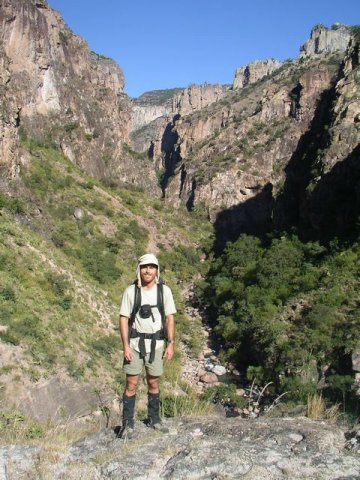
Granite Gear Vapor Trail | Descending Taracuera Canyon during my third trip to Mexico’s Copper Canyon Region in 2005.
7. Ursack Major XL – I suspect I’ll be making a lengthy trip to Alaska sometime in the next few years. When I do, I’ll be taking one of these.
8. Brooks Cascadia 13 or 12 – Now in their 13th incarnation. I’ve been using the Cascadias regularly over the past decade. They have made a bit of a comeback in recent times, after the Cascadia #10 was widely panned for its durability. Not the lightest trail runner out there, but they fit my feet perfectly, and I’ve always been a fan of the combo of comfort, stability and grip. I also know that irrespective of the terrain, I can rely on them for 500 to 600 miles.
9. Brooks Caldera 2 or 3 – I’ve only been using the Calderas for the past couple of years but have grown to like them a lot. Same durability as the Cascadias, but 5 oz lighter (per pair), more cushioning, less drop (4mm Vs 10mm) and less grip. If I was to do the PCT or CDT again, these are the shoes I’d go with. For off-trail and/or wet and slippery conditions, I still prefer the Cascadias (or even the La Sportiva Bushidos).
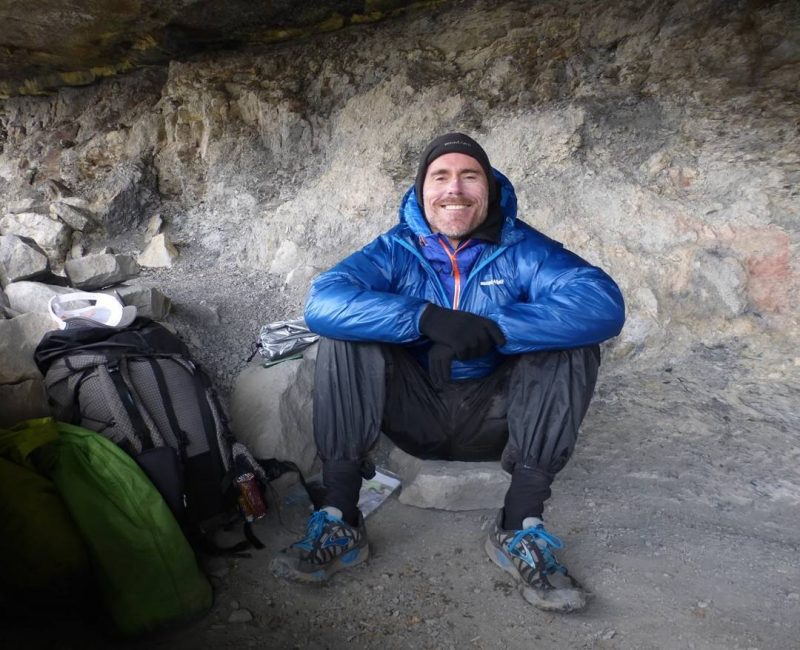
Brooks Cascadias (I think they might have been the 7’s or 8’s) | Riding out a big storm in a very welcome cave | Sierra Nevada del Cocuy, Colombia, 2015.
10. La Sportiva Bushido 2 – I picked up a pair of the Bushidos in 2017, when my size in the Cascadias wasn’t available. They feature a stiff mid-sole, grippy tread, and a 6mm heel drop. A few ounces lighter than the Cascadias; similar on the durability front. I’ve got about 400 miles on my current pair and they are still feeling ok.
11. Marmot Helium – A comfortable, accurately rated 15°F bag, that with the REI discount will set you back less than $350. That’s very good value. For more sleeping bag suggestions, see Sleeping Bags and Quilts for Thru-Hiking.
12. Patagonia Nano Puff Jacket/Insulated Hoodie – Along with the Thermawrap from Montbell, this has been my go to synthetic insulation layer for most of the past decade.

Yours truly in a Patagonia Nano Puff, accompanied by Billy Goat in his beloved Western Mountaineering Flight Jacket.
Items Under $100
For those that are interested, here is a list of items that cost under $100 that I regularly use from REI:
1. Suunto M-3G Global Pro Compass – Offspring of my beloved Suunto M-2, which is no longer made.
2. Kathoola Microspikes – Ideal traction device for icy trails during winter in the Appalachians and late spring in the High Sierra.
3. Aquamira – Water treatment of choice for more than a dozen years.
4. Loksaks 20×12 – I’ve been using loksaks since 2007; yet to have any critter issues. Seals tend to go after about five to six weeks of regular use.
5. REI Merino Liner socks – Favourite hiking socks for all but deep winter conditions. Not quite as durable as they used to be.
6. Patagonia Baggies—Comfy, durable, and quick-drying, they are worthy successors to my old Macpac Cross Terrain shorts, which are no longer made.
7. Toaks Titanium Siphon Alcohol Stove – I upgraded to the Toaks back in 2016. A lot more efficient than the Pepsi/Tuna can models that I had used in the past. Perfect for treks in developing countries, where denatured alcohol is widely available, but fuel canisters can sometimes be hard to find.
8. Platypus 2 Liter Bottles/Bladders – Reliable, light (1.3oz) and take up very little space when not in use.

Baby blue Patagonia Baggies | Badlands Traverse, 2016.
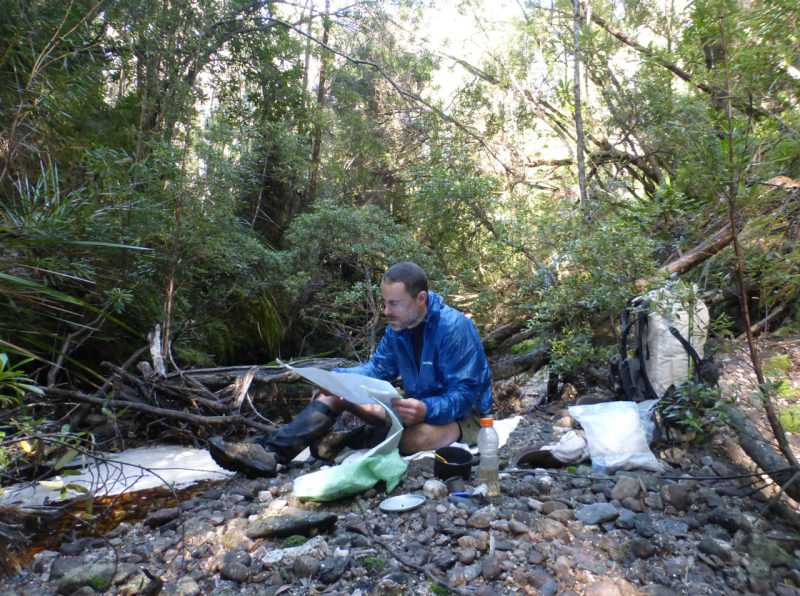
If you look hard enough, you’ll spot a Toaks siphon alcohol stove (next to the Gatorade bottle) | Southwest Tasmania Traverse, 2016.
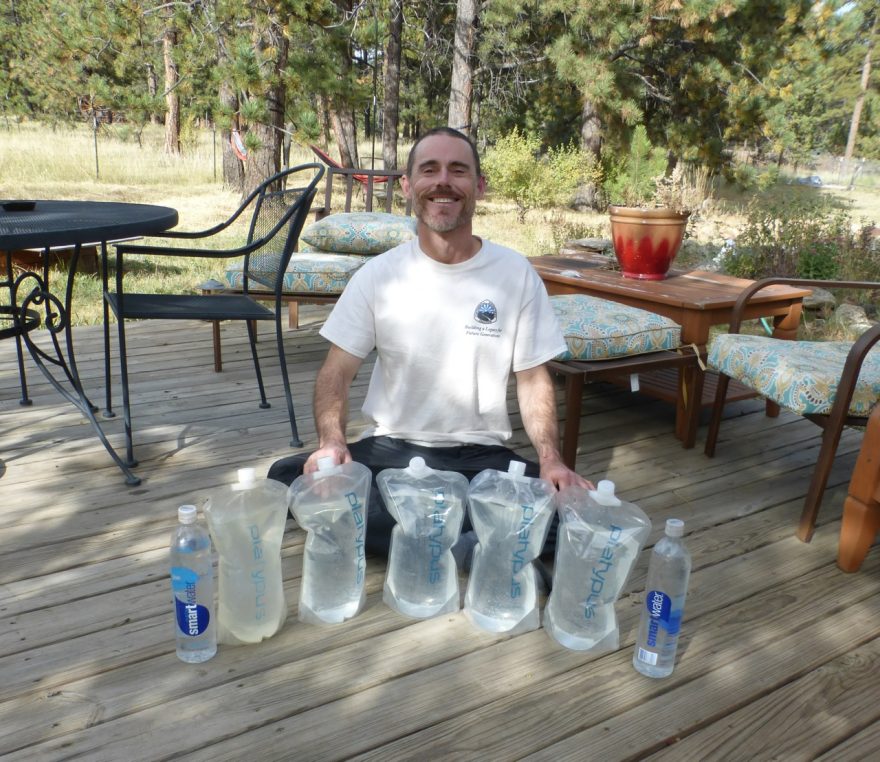
Platypus 2 Liter bladders | I started my 2016 traverse of Badlands National Park carrying more than 12 liters of water.

HMG Southwest 2400 and two 20×12 Loksaks containing 12 days of food / Southwest Tasmania Traverse, 2016.
Disclosures: I thought about calling this post “An Insider’s Guide to the REI Members Sale.” Ultimately I decided against it, because I didn’t want to run the risk misleading my burgeoning eunuch readership. Speaking of which, only a few more weeks until Game of Thrones Season 8 begins. #teamgreyworm.
On a less interesting note, this post contains some affiliate links, which means ‘The Hiking Life’ receives a small commission if you purchase an item after clicking on one of the links. This comes at no additional cost to the reader, and helps to support the website in its continuing goal to create quality content for backpackers and hikers.
Discover more from The Hiking Life
Subscribe to get the latest posts sent to your email.
Concise, practical gear choices. I had to share this (and much of what you write!) with all (almost) 10K members of the Michigan Hiking and Backpakcing FB group.
Love hearing about the trails that you’ve hiked and the books you’ve written on The Trail Show.
Thanks for a great article, Swami!
Hey Chris,
Thanks very much for the share and the support. I know there are a lot of folks out there who love their gear talk, so I’ve been trying to post a few more equipment-related articles in recent times.
Cheers,
Cam
Hi,Cam,
Are TarpTents good value/quality?
Off message here; is Billy Goat still out there, to your knowledge?
Thanks for letting me live vicariously…
Tarptent has been around for two decades, and they have always had a great reputation for value and quality. I’ve been using their tents since picking up a Squall in 2003.
In regards to Billy Goat, I haven’t talked with him for a while, but to the best of my knowledge he is still out there. He turned 80 in late January.
cheers,
Cam
Good looking out on the R1! I was looking all over for it a while back without success. I ended up with a Melezana which I like but doesn’t have the zipper. I appreciate your help. Thanks!
No worries. The Mellys are comfy, but for practical purposes I’d go with the R1 every time. The balaclava fits snugly and the zip makes it easier to regulate temps.
Hey Cam,
Thanks for the pointers. I’ve been eying the inreach mini as well.
I noticed you’re rocking the wide neo-air xlite pad now. Is that the regular-wide version or the long-wide?
Also – do you think you’ll ever go back to the narrower torso-length version again (x-lite small/short)?
I’ve been going back and forth on this for a while, but have always been inspired by guys like you who are still rocking the short pad after decades on the trail without complaint!
Cheers,
Kevin
Hi Kevin,
I have the long-wide. I’ve been thinking of cutting it down, but haven’t taken the plunge yet. Ideally, it would be great if Thermarest came out with a short-wide or even a medium-wide about 150 cm in length (wishful thinking on my behalf). As a side sleeper, I think the latter would be my ideal sleeping mat.
As for the question about going with the short-regular version in the future, yes, I think there will still be times when I use it.
Cheers,
Cam
Hi Cam,
Thank you for the clarification. I’ve considered buying a large and cutting it down as you’ve said, but so far have stuck to the short xlite. I know the jump in comfort would be big for a wide so I’m still thinking about it.
Have you ever dabbled with the uberlite?
Also – I was curious how you pack your 1/8 GG thinlight on trips where you intend to take an afternoon siesta? Do you use it as a framesheet along with your xlite? Then just unpack everything mid-day to access it? Or, do you keep it accessible, somewhere outside the pack? That way you don’t need to unpack your entire pack to grab the 1/8 thinlight and use as needed.
I ask because I know you’re a fan of the 1/8 paired with the xlite, especially for less than perfect ground conditions.
All the best and thanks as usual for the great insights!
Cheers,
Kevin
Hi Kevin,
Thanks for the message. In regard to your questions: 1. I haven’t tried the Uberlite. From the reports I’ve heard it doesn’t seem to be the most durable of mats; 2. I tend not to take siestas when I’m backpacking. Yes, I pair the ThinLight with the XLite as a makeshift framesheet.
Cheers,
Cam
Hi Cam,
Thank you for the info. I really appreciate it. This is very helpful.
Cheers,
Kevin