“A good lie can walk from Baghdad to Constantinople while the truth is still looking for its sandals.”
~ Arab proverb
Myths are like white lies with lots of staying power. The great outdoors has a bunch of them. They run the gamut from harmless and funny to non-sensical and potentially dangerous. Some of these misconceptions have been around for so long that they’ve become ingrained in our collective wilderness psyche. In the following article, I won’t debunk all the dodgy hiking related info that’s out there, but I do put a dent in ten of the most prevalent myths that have lingered around like a stubborn grass stain on your favourite white t-shirt.
Note: Excerpted and edited for length with permission from, Wiley, publisher of “Hiking & Backpacking For Dummies” by Cam Honan. Copyright ©2026 by John Wiley & Sons, Inc. All rights reserved. This book is available wherever books and eBooks are sold.

Myth #10: Climb a Tree when Confronted by a Bear (see below) // Photo: Mamma grizzly with two cubs / Day 1 – Long trek through Denali National Park, Alaska, 2021.
You Sleep Warmer Naked
This may be the number one backpacking urban legend and is possibly the easiest to disprove. Insulating layers trap heat — the more you have of them, the less heat can escape. If you’re feeling chilly in your sleeping bag while wearing your thermal base layers, add rather than subtract. In other words, put on a beanie and an extra top and voila. “Are there any situations when sleeping naked is warmer than in clothes?” Yes. If the clothes in question are wet, or if you’re sharing your sleeping bag with another naked person — which is a topic for a different type of hiking book.

All layered up on the Altiplano Traverse. With night time temps dropping down to -15°C (5°F), staying warm meant regularly wearing all my clothes inside the Katabatic Sawatch 15 quilt and Bristlecone bivy.
You Need Boots to Hike
One of the most enduring backpacking myths is that high-cut boots are essential to “protect your ankles.” You’ll hear it everywhere — gear ads, hiking clubs, online forums, even guidebooks — but there’s little scientific evidence to back it up. Plenty of experienced hikers (myself included) have logged thousands of miles in both boots and low-cut footwear, and for most three-season hiking, lighter footwear wins. Trail runners and low-cut hiking shoes hit the sweet spot: comparable support and traction, better breathability, less weight, and less fatigue. And when you’re not as tired, you’re less likely to trip and get hurt. Waterproof boots still have a place — think deep winter, snow, and freezing conditions — but they’re overkill for most three-season hikes. Just like you wouldn’t use one tent or sleeping bag for every trip, one pair of footwear doesn’t fit every hiking experience. For more information, see Trail Runners Vs Hiking Boots: A 30 Year Perspective.
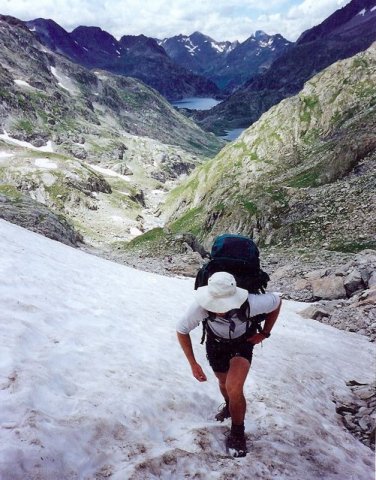
The last long three-season hiking trip I did in leather hiking boots was the Pyrenees High Route in 1999.
Waterproof Gear Is Actually Waterproof (and Breathable)
When purchasing “waterproof and breathable” rainwear, many folks assume that they are buying gear that is impervious to wet weather. Alas, the reality is somewhat different. Given enough exposure to the elements, any waterproof/breathable item — whether a jacket, pants, or footwear — will eventually get wet. That moisture may work its way in from the outside, build up from sweat on the inside, or (lucky you) both. This realization doesn’t mean that “waterproof and breathable” garments are useless. It simply means they aren’t a cure-all in cold and wet conditions. When hiking for an extended period in driving wind and heavy rain, your goal shouldn’t be to stay perfectly dry — it should be to stay warm and comfortable(ish).

“WTF……… this is the way?” – None-too-happy brother-in-law on a very cold, wet, foggy, and windy day / Arthurs Range Traverse, 2015.
Washing Dishes and Bathing in a Water Source Is Okay if You Use Biodegradable Soap
Biodegradable soap requires bacteria in the soil to breakdown properly. Using it directly in water sources can harm aquatic species and lead to increased nitrogen levels. Additionally, it may impact folks obtaining drinking water downstream — no one wants to swig soapy dishwater or H2O that’s been used to clean dirty socks and undies. On a related note, before going for a swim in a creek or waterhole, always be sure to wash off any lotion, sunscreen, or repellent to avoid contamination. The environmentally friendlier alternative is to do any dishwashing (or person cleaning) at least 200 feet (61 meters) away from water sources and then pour the water in a cathole or disperse it widely so that it won’t cipher back down to a stream, pond, or lake.

Early morning soak in one of my all-time favourite hot springs at Landmannalaugar, during the Iceland Traverse (2023) (Photo by Kate Pickett).
Never Hike Alone
“Never hike alone” is advice you’ll often hear from park rangers or overly cautious friends and family. And for beginners — or anyone heading into unfamiliar terrain or sketchy conditions — it’s generally solid advice. But it’s not a universal blueprint. Whether hiking solo is a good idea comes down to three things: your experience level, the conditions you’re hiking in, and how comfortable you are being on your own. The trouble usually isn’t hiking solo — it’s hiking solo unprepared. Problems crop up when hikers overestimate their skills or underestimate the terrain. The takeaway? Enjoy the freedom of solo hiking, but don’t let it outpace your judgment.

Sunset at Evans Creek on the Southwest Tasmania Traverse. During the west coast section of this route I saw exactly one person over the course of 15 days – a cray fisherman off the coast.
Toilet Paper Decomposes Quickly (Same Goes for Fruit)
Not as quickly as you might think. Toilet paper can take between one and three years to fully decompose. Even longer in arid environments where there is less moisture in the soil. Regarding fruit, apple cores typically decompose in a couple of months, but banana and orange peels can take up to two years (once again, even more in arid conditions). If you’re thinking that doesn’t sound too bad, consider the likelihood that wildlife in the vicinity can snap up your fruit waste before it has a chance to biodegrade. If this happens enough, it can potentially lead to habituation and compromise the creature’s ability to forage. Why would an animal want to expend all the effort to find food when hikers and campers provide them with easy meals? In other words, as is the case with TP, if you pack it in, pack it out.

Infographic from the US National Park Service and LNT.org.
Metal Items Attract Lightning
One of the most widespread hiking myths is that metal items such as trekking poles, external framed backpacks, even umbrellas with aluminium shafts, are magnets for lightning during an electrical storm. While metal is indeed an excellent conductor of electricity, its presence is irrelevant when it comes to the location at which lightning strikes. In other words, wearing a chain mail vest or a Viking helmet won’t increase your odds of being hit. When an electrical storm is approaching, what you really want to avoid is being the tallest object in your vicinity — whether it be a ridge, field or mountain top.

Long-time trekking pole user (and occasional viking helmet wearer), Greg “Malto” Gressel, hiking the Teton Range Traverse with a thunderstorm looming (October, 2016).
You Can Suck the Venom Out of a Snakebite
From old Western movies to “snakebite kits” with suction cups, tourniquets and razorblades (!), the myth that you can suck (or cut) the venom out of a snakebite continues to this day. Two main points to remember: 1. It doesn’t work. Venom travels quickly through the body via the lymphatic system — by the time you start sucking or cutting, the toxin-ship has already sailed, and 2. You can potentially make a crappy situation even worse, by introducing germs into an open wound, which may lead to infection. See Tips for Hiking in Snake Country for more information.

Close encounter with a Cottonmouth in Big Cypress National Preserve / Florida Trail, 2012.
“I’m Just One Person: The Shortcut Won’t Cause Too Much Damage”
This is the little voice hikers hear when they know they’re about to do something they shouldn’t. Whether it’s cutting switchbacks or stepping off trail to avoid muddy feet, the impact of one person leaving the trail can seem insignificant. The problem? You’re almost never the only hiker thinking the same thing.
When many hikers repeatedly stray off designated trails, the damage adds up quickly. The repercussions include large-scale erosion, damaged vegetation, altered drainage patterns, and paths that widen into quagmires. Shoes can be cleaned. You can dry your feet at day’s end. Damaged plant life and erosion are not so easily remedied. The solution is simple: if you’re on an established trail — muddy, wet or winding — stick with it. Take a deep breath, channel your inner- Buddhist, and follow the “middle way.”

Greg “Malto” Gressel following the “middle way” during a biblical storm in New York’s Adirondack Mountains, 2015,
Climb a Tree when Confronted by a Bear
You may have seen this survival strategy on TV or in the movies. And I get it. Bears don’t look like they’d be great climbers — too big, too lumbering. Mountain lions and cougars are the ones that can scale trees. “Wouldn’t bears be too heavy for the branches?” Think again. Black bears (which typically weigh 150 lb/68 kg to 250 lb/113 kg) are significantly more adept at climbing than humans, and after you’re high up in a tree, your options of escape are limited to your ability to defy gravity. “What about brown and grizzly bears, which are even larger?” While not as good at climbing as black bears, they can still scale a tree when their chase instinct has been triggered, and do you really want to gamble on branch strength (or lack thereof) when facing a 600 lb/272 kg bruin? See Tips for Backpacking in Bear Country for more details.

Bruin at dusk on Canada’s Great Divide Trail (2011)………….no trees were climbed – pictured or otherwise.
Where to Buy Hiking & Backpacking for Dummies?
- Wiley
- Amazon
- Bookshop.org
- Walmart
- Barnes & Noble
- Booktopia (Australia)
Prefer to buy local? Ask your bookstore to order Hiking & Backpacking for Dummies using ISBN: 978-1394350254.
Related Posts
-
- Introducing My New Book: Hiking & Backpacking for Dummies
- A Quick & Dirty Guide to the Pyrenees High Route
- 12 Long Walks – Maps, Stats, and Journals
- Chris Townsend – Why Lightweight Footwear?
- Southwest Tasmania Traverse
- Altiplano Traverse
- Arthurs Range Traverse Planning Guide
- Trail Runners Vs. Hiking Boots: A 30-Year Perspective
- Tips for Backpacking in Bear Country
- Tips for Hiking in Snake Country
Discover more from The Hiking Life
Subscribe to get the latest posts sent to your email.
Just bought the book at my local! Based on your experience and gear posts I hope to be able to recommend it to my scout troop, even though I have to admit I am not in general a fan of the whole “Dummies” schtick. Should be “siphon”, not “cipher”, BTW.
Hi Walter,
Thanks for your support! I hope there’s a lot of information in there that your scout troop will find useful.
Cheers,
Cam
Lightning: a lot of genuine stories out there about people being struck by lightning and even killed and they are NOT the tallest thing around. Granted, get off the top of the pass. But being down low gives you no guarantee. I was on top of Island Pass on the JMT when a massive bolt and clap hit on Thousand Island Lake, well below me. I thought I was going to be deaf after that! Hikers coming my direction (away from the lake) were looking shell shocked or even weeping. Rough day. I hated clouds for the next two weeks, with a passion.